- Home Page /
- Books /
- Business & Money Books /
- Business Economics Books /
- Money & Monetary Policy /
- Corporate Sector Vulnerabilities and High Lev...


Item #:
136807337
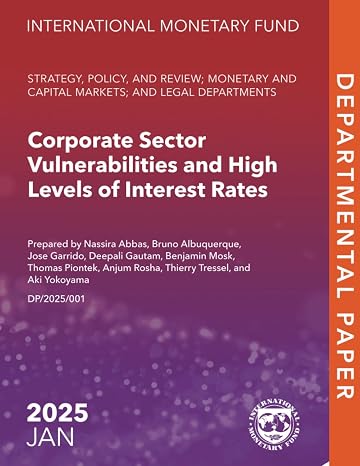
Corporate Sector Vulnerabilities and High Levels of Interest Rates (IMF Departmental Papers)
97% of respondents would recommend this to a friend
Item #:
136807337
AUD 49
Price Details
Excluding Shipping & Custom charges ( Shipping and custom charges will be calculated on checkout )
*All items will import from US
In stock
 Imported from USA store
QTY:
Order now and get it around Saturday, October 03
Secured transaction
Ubuy works hard to protect your security and privacy. Our advanced payment security system ensures confidentiality by encrypting your information during transmission using AES (Advanced Encryption Standards) and SSL (Secure Socket Layer) protocols. Your payment details are 100% secure as we do not share your payment details with third party sellers.
Our Top Logistics Partners


Design and deploy appropriate policies that may prevent and mitigate risks from the corporate sector in a new environment of high interest rates.

Fast
Shipping

Free
Return*

Secure Packaging

100% Original Products

PCI DSS Compliance

ISO 27001 Certified



Note: Step Down Voltage Transformer required for using electronics products of US store (110-120). Recommended power converters Buy Now.


What Stands Out
In-depth Analysis
Provides comprehensive insights into vulnerabilities within the corporate sector, enabling readers to understand complex financial dynamics and their implications in fluctuating interest rate environments.
Expert Perspectives
Authored by IMF economists, offering authoritative viewpoints and recommendations, making it an essential read for policymakers and business leaders navigating economic challenges.
Timely Publication
Released in January 2025, this paper addresses current economic conditions, ensuring relevance and applicability for stakeholders looking to adapt to evolving financial landscapes.
Product Details
- This paper provides a comprehensive overview of corporate sector vulnerabilities that have emerged post-pandemic. The main focus in on the financial stability implications from corporate sector vulnerabilities in a new environment of high interest rates. Although several central banks have recently started cutting interest rates, the expectation is that high interest rates, above pre-pandemic levels, are here to stay. It is then especially important to design and deploy appropriate policies that may prevent and mitigate risks from the corporate sector. The main findings of the paper are as follows. First, the paper finds that interest rate increases may transmit more strongly to the real economy in the current environment since the global share of financially distressed firms has been trending upwards, especially in emerging markets (EMs). Moreover, the lagged effects of past monetary policy tightening may have adverse effects on firms’ capacity to invest. Second, an adverse macroeconomic scenario of negative demand shocks coupled with higher interest rates would lead to a fast and large increase in corporate defaults. Financial stability risks would increase materially, especially for EMs and less-developed banking systems, as bank capital buffers would fall considerably in this scenario. Third, the increasing role of nonbanks in corporate credit intermediation in advanced economies may amplify overall financial stability risks. This paper closes some of the data gaps and shows that since the GFC, nonbanks have been increasing their exposure to riskier firms and to the less productive segment of the economy, including zombie firms and nontradable firms. The migration of credit to the unregulated sector raises concerns about the propagation of risks to the rest of the financial system from a potential corporate default cycle. It is paramount to continue closing data gaps in this sector, while extending the regulatory perimeter to nonbanks to improve the overall resilience of the financial sector. Finally, the paper documents some progress on insolvency and restructuring regimes to deal with corporate distress since the pandemic. Nevertheless, several shortcomings persist that prevent countries from resolving firms quickly in a potential scenario of an intensification of corporate distress.
| Publisher | International Monetary Fund |
| Publication date | January 13, 2025 |
| Language | English |
| Print length | 74 pages |
| ISBN-13 | 979-8400292385 |
| Item Weight | 8.8 ounces (249.48 grams) |
| Dimensions | 8.5 x 0.18 x 11 inches (21.6 x 0.5 x 27.9 cm) |
Who Should Buy?

-
Business Analysts
This product offers insights into corporate sector vulnerabilities, aiding analysts in making informed financial assessments.
-
Economic Researchers
Relevant data and analysis will support researchers exploring the impact of interest rates on corporate health.
-
Policy Makers
Supply valuable information for legislators focusing on fiscal policies and economic strategies affecting corporations.

-
General Readers
The technical nature of the content may be too complex for those without a background in economics.
Product Description
Have any Query? Chat with us
Customer Questions & Answers
-
Question:
What is the main focus of the IMF Departmental Paper on Corporate Sector Vulnerabilities and High Levels of Interest Rates?
Answer: The IMF Departmental Paper primarily examines how rising interest rates impact the corporate sector, particularly focusing on financial vulnerabilities. It analyzes how increased borrowing costs can strain corporate finances, leading to potential defaults and reduced investment. Understanding these dynamics is essential for policymakers and stakeholders, as it highlights the interconnectedness of interest rate changes and corporate financial health, which can have broader implications for economic stability and growth. -
Question:
Who benefits from reading the IMF paper on Corporate Sector Vulnerabilities?
Answer: Investors, economists, and corporate executives can significantly benefit from this paper. By gaining insights into the correlation between high interest rates and corporate vulnerabilities, stakeholders can make informed investment decisions or strategic corporate financing choices. For instance, an investor might decide to adjust their portfolio to minimize exposure to high-leverage companies as interest rates rise, ensuring better returns during economic fluctuations. -
Question:
How can governments utilize the findings of the IMF paper?
Answer: Governments can leverage the insights from the IMF paper to structure more effective monetary policies. By understanding the vulnerabilities within the corporate sector, authorities can better assess the risks posed by higher interest rates and implement measures to support struggling firms. For instance, targeted fiscal policies or incentive programs can be developed to aid businesses that are at risk due to rising borrowing costs, ultimately fostering economic resilience. -
Question:
What are the potential risks discussed in the paper regarding corporate sector vulnerabilities?
Answer: The paper outlines several risks, including increased default rates, reduced capital investment, and potential layoffs. As borrowing becomes costlier, corporations may struggle to service their debts, leading to defaults that can have cascading effects on the broader economy. A corporation facing such vulnerabilities might delay expansion plans or cut staff, which could ultimately lead to slower economic growth and decreased consumer confidence. -
Question:
Does the IMF paper provide solutions for corporate vulnerabilities caused by high interest rates?
Answer: Yes, the paper offers recommendations for mitigating corporate vulnerabilities, including better risk assessment practices and strategic financial planning. It suggests that firms conduct stress tests and scenario analyses to prepare for various interest rate environments. By implementing these measures, companies can enhance their resilience, such as maintaining adequate liquidity and diversifying funding sources, enabling them to withstand interest rate increases more effectively. -
Question:
Are there any case studies included in the IMF paper?
Answer: The paper includes various case studies that illustrate the real-world impacts of interest rate changes on corporate sectors across different economies. These case studies demonstrate how firms in similar situations have navigated their financial challenges, providing practical insights for other organizations. For instance, a case study may detail how a manufacturing firm successfully adapted its financing strategy to hedge against rising costs, serving as a model for others facing similar conditions. -
Question:
How does the IMF paper relate to Tuvalu economic trends?
Answer: The IMF paper is closely tied to Tuvalu economic trends, as corporate sector health is a critical indicator of broader economic stability. With interest rates playing a significant role in shaping economic activity, the paper helps explain how shifts in these rates can affect corporate behavior worldwide. Understanding these trends can assist business leaders and policymakers in anticipating changes in investment patterns and economic growth trajectories, facilitating better strategic decisions. -
Question:
What role does interest rate policy play in corporate financial health according to the paper?
Answer: According to the paper, monetary policy regarding interest rates directly impacts corporate financial health by influencing borrowing costs. Higher rates can reduce access to capital and lead to increased debt servicing costs for corporations. For example, a corporation may find it more challenging to finance new projects or pay off existing debt as interest rates rise, necessitating strategic adjustments in their financial management to sustain operations and growth. -
Question:
How can individuals access the IMF Departmental Paper?
Answer: To access the IMF Departmental Paper on Corporate Sector Vulnerabilities and High Levels of Interest Rates, individuals can visit the official IMF website or academic databases that host their publications. These platforms typically offer various formats, enabling users to download or read the paper online, making it convenient for researchers and interested readers to access the material directly. -
Question:
Where can I buy Corporate Sector Vulnerabilities and High Levels of Interest Rates (IMF Departmental Papers) in Tuvalu?
Answer: You can buy Corporate Sector Vulnerabilities and High Levels of Interest Rates (IMF Departmental Papers) from Ubuy in Tuvalu. Ubuy offers a wide selection of documents and papers, making it a reliable source to obtain valuable economic insights like those provided by the IMF. Simply search for the paper on their website, and you will find options to purchase and access this important piece of research.
Money & Monetary Policy Editorial Review
No editorial reviews found
Customer Reviews & Ratings
1 customers ratings
-
5 Star
100%
-
4 Star
0%
-
3 Star
0%
-
2 Star
0%
-
1 Star
0%
Review this product
Share your thoughts with other customers
Platform Trust & Buyer Confidence

JK
Jasmin
Verified buyer
“Great products and very good service: very easy and very fast international delivery.”
9 September 2026 · via Trustpilot
AG
Anke
Verified buyer
“Wonderful online shopping experience, smooth transaction from the start. Payment method works conveniently and delivery is unexpectedly fast and reliable. You go the extra mile for service. What makes this even more amazing, you deliver to Namibia. I will remain a happy Ubuy customer and will increase my purchases for sure! Thank you!”
10 September 2026 · via Trustpilot
H
Hazel
Verified buyer
“Very easy to find the products what you need, and so fast delivery, that’s why I highly recommended to others costumers to used ubuy.”
10 September 2026 · via Trustpilot
O
Opaleye
Verified buyer
“I received exactly what I ordered I was skeptical about your site because that was my first time to order. But the order came timely and neatly packaged. I was not disappointed. Thank you.”
11 September 2026 · via Trustpilot
AC
Adele
Verified buyer
“Easy to find and order what you want on the website. Delivery is quick to the UK”
8 September 2026 · via Trustpilot
Secure Checkout
Global Delivery
Easy Returns
Genuine Products
Product Price History
Important information
- Limitations : For products shipped internationally, please note that any manufacturer warranty may not be valid; manufacturer service options may not be available; product manuals, instructions, and safety warnings may not be in destination country languages; the products (and accompanying materials) may not be designed in accordance with destination country standards, specifications, and labeling requirements; and the products may not conform to destination country voltage and other electrical standards (requiring use of an adapter or converter if appropriate). The recipient is responsible for assuring that the product can be lawfully imported to the destination country. When ordering from Ubuy or its affiliates, the recipient is the importer of record and must comply with all laws and regulations of the destination country.
- Not all the products listed on Ubuy are for sale, as Ubuy is a global search engine. Products are subject to export/trade regulations.
AUD 49
Order now and get it around Saturday, October 03
This item is not restrict in my country.(Please click on above link if this item is not restrict in your country, So our team will review and allow.)
QTY:
Secured transaction
PCI DSS compliant and ISO 27001:2022 certified, with encrypted payments and full buyer protection on every order.
Our Top Logistics Partners
Fastest cross-border delivery
Features & Benefits
- Comprehensive overview of post-pandemic corporate vulnerabilities.
- Focus on financial stability implications from high interest rates.
- High interest rates are expected to remain above pre-pandemic levels.
- Interest rate increases may have a strong impact on financially distressed firms, especially in emerging markets.
- Risk of corporate defaults significantly rises in adverse economic scenarios.
- Regulatory measures are necessary for improved resilience in the financial sector.
Ubuy Assurance
Experience worry-free shopping with 100% original products, PCI DSS-compliant payment security, ISO 27001-certified data protection, the fastest cross-border delivery, free returns *, and secure packaging on every order.